Visual learning has always been an important part of our learning process. Still, the emergence of the internet and the subsequent growth of online learning has brought it to the center of our learning experience.
Most successful online courses today use videos, infographics, presentations, etc., as the primary learning format, and there is a good reason behind it.
There is enough visual learning research that supports the argument that it is faster, easier, and more effective to learn visually.
And in this article, we will discuss several visual learning statistics and facts to illustrate its effectiveness.
Let’s start with this infographic that summarizes the key advantages of visual learning:
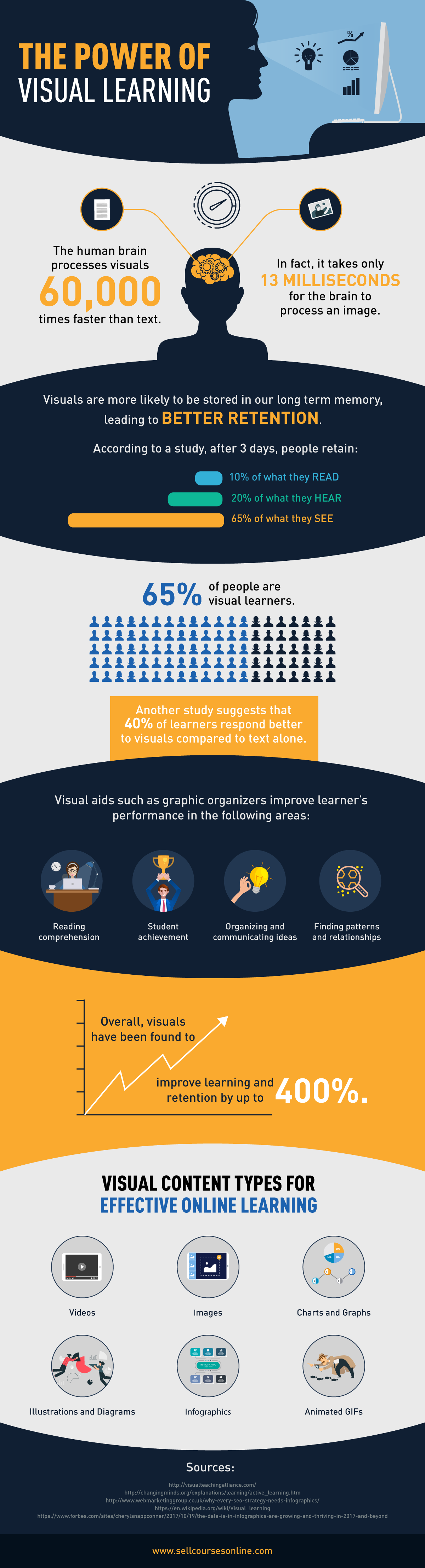
We can notice and make sense of visual information much faster than we can read any text.
For example, when it comes to recognizing patterns in data—most of us find it easier to look at infographics, charts, or graphs than spreadsheets.
While you may be able to relate to the idea intuitively, they are also backed by research. According to the Visual Teaching Alliance:
The whole thing becomes even more important when you consider the fact that the attention spans of humans are getting shorter.
In fact, one study suggests that the average person gets distracted in 8 seconds, though a mere 2.8 seconds is enough to distract some people.
As a result, it’s vital for you as an educator to communicate your message to the learners quickly, so you need to use more visual content like videos and images while teaching online classes.
A key aspect of effective learning is to be able to remember information over the long term.
Through visual learning, our brains associate concepts with meaningful images, which helps us store those concepts in our long-term memory.
According to Dr. Lynell Burmark, an education consultant, “Words are processed by our short-term memory where we can only retain about seven bits of information. Whereas, images are directly processed by our long-term memory, where they get indelibly etched.”
Now, there is enough research that also suggests that learning through visuals increases the likelihood of us storing information in our long-term memory.
One study showed that after three days of learning new information, users remembered only 10-20% of what they learned through text or voice but retained 65% of what they learned visually.

According to another study, an illustrated text was 9% more effective than text alone when immediate comprehension was tested and 83% more effective when the test was delayed.
Moreover, visual elements also reinforce important takeaways, making us more likely to remember key pieces of information over the long term.
Visual cues ignite our imagination, help us create new associations, and rearrange existing patterns in memory. Visual elements also help us simplify complex ideas by making it easy to break down concepts and reorganize information.
So it’s hardly surprising that visuals improve our overall ability to understand concepts in greater depth and granularity and increase ‘‘human bandwidth’ for learning.
According to Robert E.Horn from Standford University, “When words and visual elements are closely entwined, we create something new and we augment our communal intelligence … visual language has the potential for increasing ‘human bandwidth’—the capacity to take in, comprehend, and more efficiently synthesize large amounts of new information.“
There has been a lot of research that supports these ideas and suggests that visuals improve comprehension and other learning outcomes.
According to a study, visuals have been found to improve learning by up to 400 percent.
Other studies have found that visuals such as cognitive organizers improve learner performance in areas including:
Visual memory is stored in the same part of our brain where emotions are processed. Visual stimuli, our emotional responses to them, and the act of forming memories are closely linked.
So, visuals can trigger strong emotions in us, and we often tend to remember the pairing of emotions and visuals in vivid detail.
And it’s not just about evoking strong responses. Even a subtle level of emotional engagement with the learning material can increase our attentiveness and spike our interest level in the subject.
As a result, visuals that engage us emotionally can dramatically improve learning outcomes. On the other hand, dry content which triggers no emotional response is likely to be ignored by our brains.
Visuals are much more effective at holding learners’ attention, retaining their interest, and motivating them to learn new information.
As 65% of people are visual learners, they pay close attention to information-carrying images. In fact, when the images are relevant, readers spend more time looking at the images than they do reading the text on the page.
Another study suggests that around 40 percent of learners find visual information more helpful than text alone.
Online course creators can benefit from this awareness to incorporate visual elements and storytelling to motivate students.
There are a few things to remember while incorporating visuals in online learning because their wrong use can easily distract learners.
Firstly, you shouldn’t use visuals for purely aesthetic reasons; instead, you should use them to represent specific ideas and objects, simplify complex concepts, and connect new ideas with old concepts.
Secondly, things like low-resolution images, overuse of stock photography, and generic visuals should be avoided, as they can cause learners to lose interest.
Thirdly, you can use several visual content formats in your training programs, such as videos, images, infographics, illustrations, etc. Fortunately, the best platform for online courses supports these formats.
Finally, how visuals are paired with other forms of content is equally important as the quality of visual elements itself.
In a nutshell, visual learning can play a powerful role in improving learning outcomes, especially if used thoughtfully and strategically.
We hope you found this visual learning statistics guide helpful. If you have any questions, please let us know in the comments below.
An online community platform is a software that lets you create a website where people with common interests can connect and interact. The platform provides the infrastructure for members to communicate and collaborate with each other, share content, and participate in activities and events.
Choosing the right platform for your community depends on the type of community you’re building, the features and functionality you need, your technical know-how, and your budget. However, a good community builder should offer the essential tools for content creation, community organization, member management, moderation, etc.
Circle is the best all-around community platform that works well for creators as well as brands. In addition, Mighty Networks and BuddyBoss are also great options for creators.
BuddyBoss is the best community plugin for WordPress users, as it is the only robust WordPress-based option that offers a complete suite of community-building features. It also integrates with other popular plugins like LearnDash and Gamipress.
The best way to get your community app is to subscribe to a community builder that lets you create branded apps. There are a few providers out there, like Mighty Networks, BuddyBoss, and Disciple, that provide this service.
There are many ways to build community engagement, but some of the most effective methods include creating valuable content, hosting events and meetups, community gamification, etc.

Hey there! I'm Baidhurya, the brains behind SellCoursesOnline. I used to run a digital agency, where I helped course businesses launch their eLearning platforms. I also led the tech and marketing teams at StationX, helping it grow to 500K+ students. In addition, I created the popular supply chain network design course. With 8+ years of experience, I'm here to share my expertise and insights on course creation and platforms with you.
SellCoursesOnline is supported by its audience. When you purchase through links on our site, we may earn affiliate commissions. However, this doesn’t influence our reviews or product listings. All opinions are based on our tests and personal experience with a product/service.
Copyright © 2024 by SellCoursesOnline
Hey there! I’m Baidhurya, the brains behind SellCoursesOnline. I used to run a digital agency, where I helped course businesses launch their eLearning platforms. I also led the tech and marketing teams at StationX, helping it grow to 500K+ students. In addition, I created the popular supply chain network design course. With 8+ years of experience, I’m here to share my expertise and insights on course creation and platforms with you.

We respect your privacy and will never spam you.